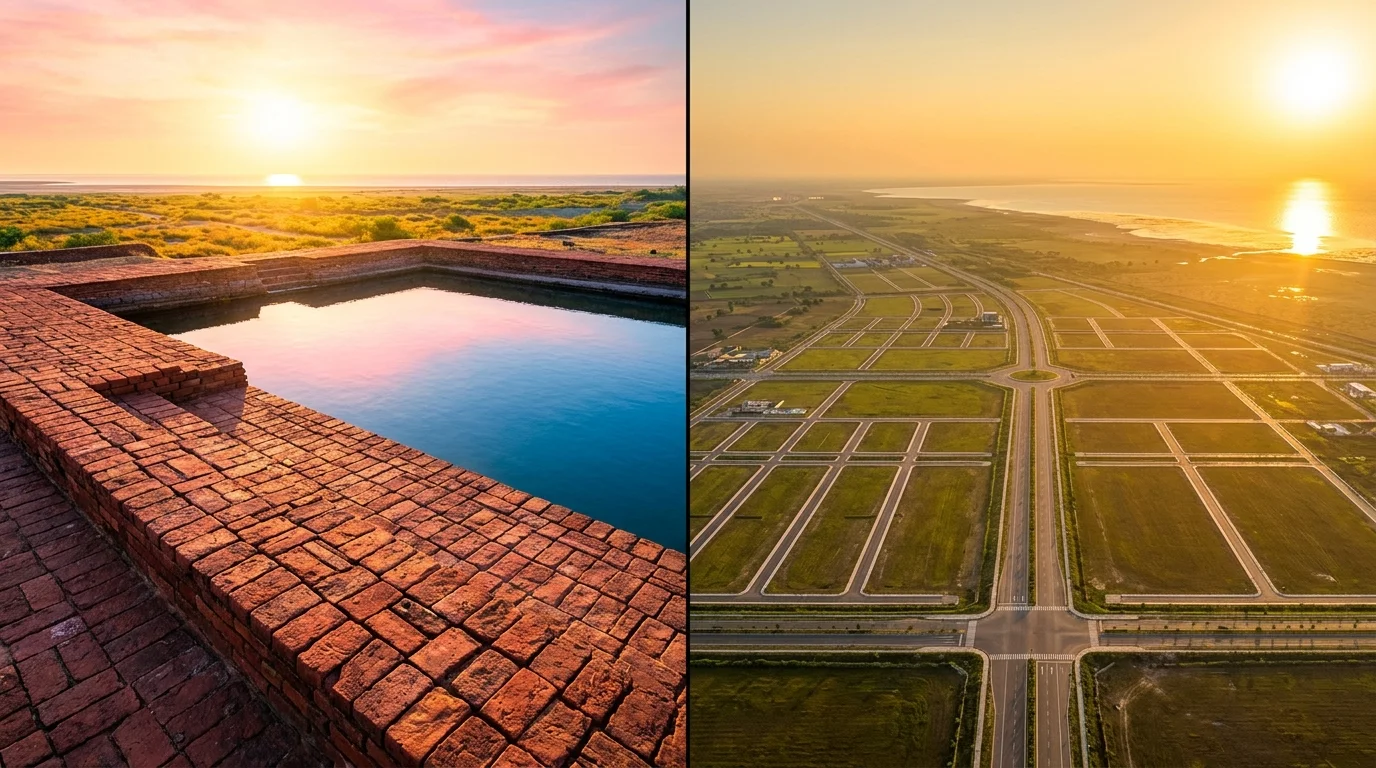
In 2400 BCE, traders loaded carnelian beads and cotton textiles onto boats at a purpose-built dock on the Gulf of Khambhat. The dock's bricks were precisely kiln-fired to uniform dimensions. The city had a grid-planned layout, underground drainage, and standardised weights and measures.
In 2026 CE, India is building its largest greenfield smart city 36 km from that same dock — with grid-planned roads, underground utilities, standardised infrastructure, and a port access corridor to the same Gulf.
Lothal and Dholera SIR are two port cities on the same coastline, separated by 4,400 years. The geography did not change. The logic did not change. Only the technology changed.
Lothal — What Was Actually Found
The Archaeological Survey of India began excavations at Lothal in 1955 under Dr S.R. Rao. What they found over six excavation seasons reshaped understanding of the Indus Valley Civilization.
- 📅 Active period: ~2400 BCE to ~1600 BCE (800 years of continuous habitation)
- 🏗️ The dock: 37m × 22m trapezoidal basin, brick-lined, connected to an ancient river channel draining to the Arabian Sea — the world's earliest known purpose-built dock
- 🌍 Trade connections: Mesopotamia, Egypt, Persian Gulf — Indus seals found at Sumerian sites; Egyptian-style beads found at Lothal
- 📐 Urban planning: Grid layout, underground brick-lined drains, public granary, acropolis and lower town
- ⚖️ Standardisation: Weights in binary and decimal systems; uniform brick sizes matching Mohenjo-daro and Harappa standards
- 🔬 Science confirmation: National Institute of Oceanography confirmed marine microfossils at the dock — a functional marine dock, not an irrigation tank
In September 2024, new geophysical studies using ground-penetrating radar re-confirmed the dock's structure. The site is on UNESCO's Tentative World Heritage List since 2014.
The Same Coastline, The Same Logic
Why did the Indus Valley Civilization build Lothal on this particular stretch of Gujarat coast? The same reason India built Dholera SIR here in 2009.
The Gulf of Khambhat is India's closest maritime access point for the entire Indo-Gangetic plain — the continent's densest agricultural and commercial heartland. The geographical logic that made this coastline the world's first purpose-built port civilization in 2400 BCE is the same geography that makes it India's most logical industrial corridor in 2026.
Geography does not argue. It just persists.
The Parallel That Should Unsettle Sceptics
Sceptics of Dholera say: "It has been planned for years. Nothing is happening."
Lothal was abandoned ~1600 BCE — likely due to river channel silting and shifting trade routes. For the next 3,600 years, it was just another Gujarat village, indistinguishable from the surrounding landscape.
Then excavation began in 1955. The dock emerged. The bead factory emerged. The international trade network emerged. All of it had been there, invisible, waiting.
Dholera in 2022–24 looked to casual observers like a flat, empty Gujarat plain. Today: expressway open, airport runway complete, ₹91,000 Cr fab 50% constructed, rail approved. Same place. Same geography. Same logic. Different chapter.
NMHC Lothal — The Museum That Connects the Two Cities
- 💰 Investment: ₹7,500 crore total (₹4,500 Cr Phase 1A + ₹3,000 Cr Phase 1B)
- 📐 Scale: ~400 acres — world's largest maritime museum by area when complete
- 🏗️ Contractor: Tata Projects — Phase 1A construction 60%+ complete as of 2026
- 🚆 Rail connection: ₹20,667 Cr semi-high-speed rail (Cabinet approved May 13, 2026) includes a dedicated 20.4 km spur to NMHC Lothal and Dholera Airport
- 🌍 UNESCO: Tentative World Heritage List since 2014 — full nomination under review
When NMHC opens, a visitor will take a semi-high-speed train from Ahmedabad, arrive at a museum telling the story of the world's first port civilization, then drive 36 km to see the greenfield smart city built on the same coast. That narrative does not exist anywhere else on earth.
For Investors: Why the Heritage Story Drives Land Value
Heritage tourism is a hard economic driver. Hampi (World Heritage Site 1986) — surrounding land 50–100× growth over 20 years. Mahabalipuram (1984 listing) — now a significant hospitality and residential market.
NMHC Lothal visitor projections: 25–35 lakh per year at full operation. The museum is 36 km from Rajpath Supreme 1 and 2. Every visitor sees Dholera SIR's infrastructure — the expressway, the airport, the skyline of the emerging smart city.
Want to see Lothal and the plot on the same day?
Saurabh's site visit: Ahmedabad → Expressway → Airport → NMHC Lothal → Project plots → Ahmedabad. One day. Free.
Zero brokerage · No sales pressure
Continue Reading