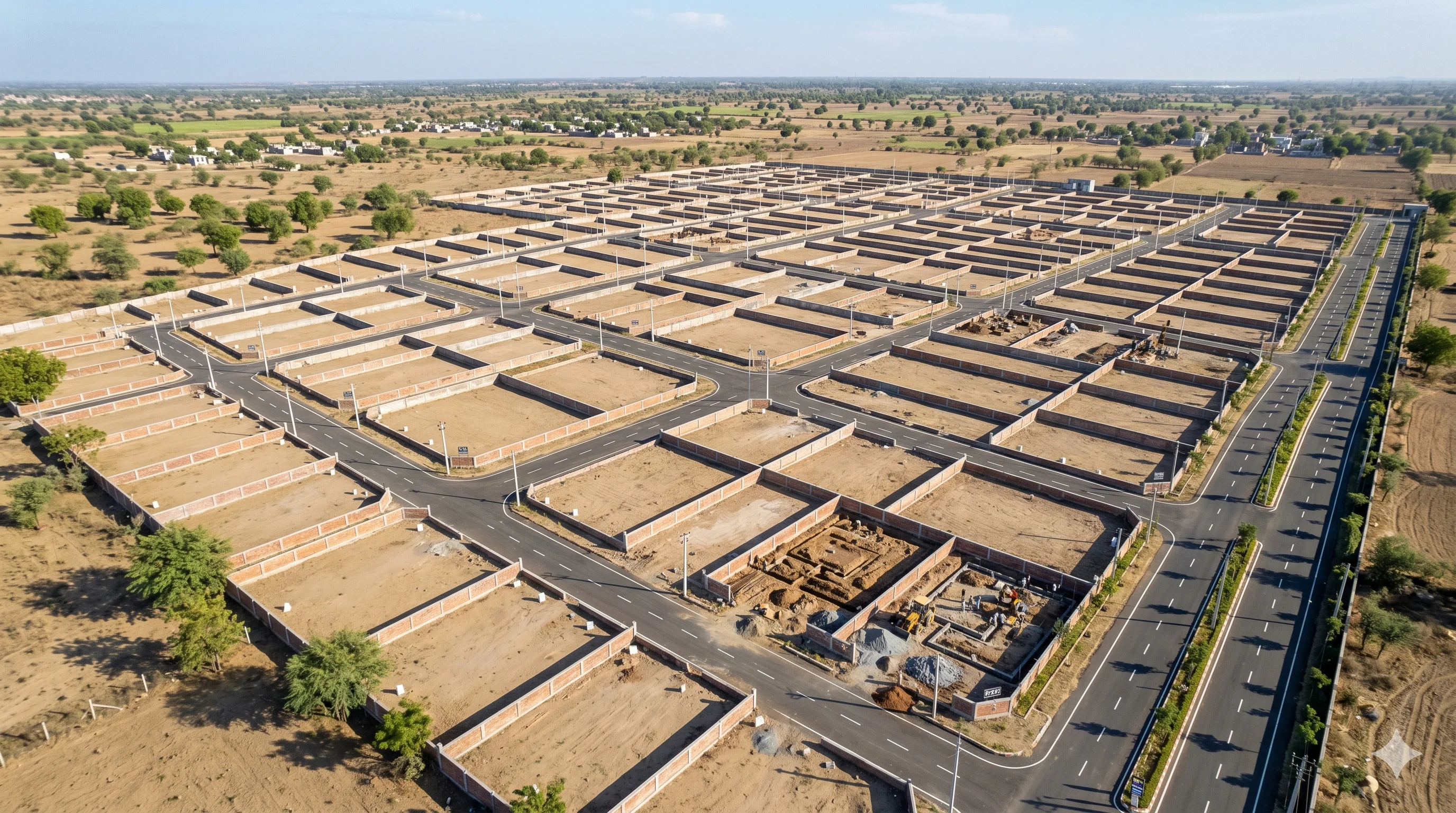
The most common question I get from buyers who have done their research: "Is the plot I am looking at inside the activation zone or outside?" It sounds like a technical question. It is actually the most important investment question you can ask about a Dholera plot.
I have visited Dholera 4 times. I have walked the activation zone boundary and I have seen both sides of it. Here is the honest picture.
What Is the Dholera Activation Zone?
Dholera SIR (Special Investment Region) is 920 sq km — roughly the size of Delhi NCR. But not all of it is equally developed.
The Government of India and DSIRDA identified a priority 22.54 sq km area — called the Activation Zone, and officially referred to as the Activation City in DSIRDA project documents — where all Phase 1 infrastructure investment is concentrated. This is the zone that has received roads, underground utilities, water, power, and government buildings first.
- 📍 Location: TP1 and TP2 town planning schemes, Dholera SIR
- 📐 Area: 22.54 sq km (Phase 1 Priority Zone)
- ✅ Roads: 72+ km of developed roads inside the zone
- ✅ Water: Narmada canal connected — underground distribution
- ✅ Power: Industrial + residential grid connected, 1,200+ MW solar park
- ✅ Telecom: Underground OFC (optical fibre cable) conduit laid
- ✅ Drainage: Storm water and sewage network installed
- ✅ Government buildings: ABCD Building (DSIRDA HQ) operational inside zone
- ✅ Industrial anchor: Tata Semiconductor plant — 50% construction complete, April 2026
Outside this 22.54 sq km zone — the remaining 897+ sq km of Dholera SIR — infrastructure has not yet been delivered. Roads, water, power, drainage — all are in future phases.
What Is Outside the Activation Zone?
Plots outside the activation zone are inside Dholera SIR boundaries, but they are in undeveloped Phase 2+ areas. Today:
- No developed roads (or only earthwork-level roads)
- No water supply connection
- No power grid connection for residential use
- No drainage or sewage infrastructure
- Timeline to infrastructure delivery: 8–15 years, minimum
This is not illegal land. The title can be clean. The RERA number can be valid. But the infrastructure is not there — and will not be for many years.
Activation Zone vs Non-Activation Zone — The Comparison
| Parameter | Activation Zone (TP1, TP2) | Outside Activation Zone |
|---|---|---|
| Infrastructure | ✅ Roads, water, power, telecom done | ❌ Future phases — 8–15 years out |
| Tata Semiconductor | ✅ 50% construction complete, inside zone | ❌ Not in proximity |
| Price | Higher — ₹1,000–1,300/sqft range | Lower — ₹400–700/sqft range |
| Appreciation history | 60–90% in 5 years (2020–2026) | 30–50% in same period |
| Secondary market liquidity | Active — buyers available | Limited — harder to find buyers |
| Build permission | Can apply for building plan now | Not yet — utilities not connected |
| Investment timeline | 5–7 years to meaningful appreciation | 10–15 years to infrastructure delivery |
| Who should buy | Investors wanting infrastructure-backed land | Very long-term (15+ year) speculators only |
The Price Premium — Is It Worth It?
Activation zone plots cost 50–100% more per sqft than outside-zone plots. This raises a fair question: is the premium justified?
My honest answer: yes — if your investment horizon is 5–7 years.
Here is why. The activation zone's price has appreciated 60–90% in 5 years on the back of visible, delivered infrastructure. Outside-zone plots have appreciated 30–50% in the same period — and they will deliver most of their appreciation only when infrastructure actually arrives, which is 10–15 years away.
For a 7-year investor, paying 60% more for activation zone land that has 2–3x the catalyst density is rational. For a 15-year investor with a very small budget who wants maximum leverage, outside-zone land might be considered — but only with full awareness that infrastructure could take longer than projected.
How to Verify Which Zone Your Plot Is In
Three steps — do all three:
- Ask for the TP scheme number: Activation zone plots are in TP1, TP2, or TP4 (TP4 is adjacent to TP2, also activated). If a seller says TP3, TP5, or gives no TP number — verify independently before paying anything.
- Check DSIRDA official site map: Visit dsir.gujarat.gov.in → Development plan section. The activation zone boundary is shown on the official land use map.
- Ask for a plot location certificate: A legitimate developer can provide a letter confirming the plot's TP scheme, sector number, and activation zone status. If they cannot provide this — it is a red flag.
What I Saw on My 4 Visits
I have visited Dholera in 2020, 2022, 2024, and early 2026. The transformation inside the activation zone between visits is visible to the naked eye:
- 2020: Roads partially laid, Tata plant groundbreaking had just happened
- 2022: 72 km of roads substantially complete, ABCD Building operational
- 2024: Underground utilities visible — conduit covers on roads, Narmada water pipeline work
- 2026: Tata plant construction clearly advanced (large structures visible), expressway driving experience is smooth, airport approach road being surfaced
Outside the activation zone: some earthwork, but largely the same as the fields I saw in 2020. The contrast is stark.
When someone shows you a plot at ₹450/sqft and says it is "Dholera SIR" — technically it may be. But ask them to show you on the official zone map where that plot is. The answer will explain the price difference.
Want to know whether a specific plot is inside the activation zone?
Send me the project name, TP scheme, and sector. I will verify it in 15 minutes. No obligation. I'd rather you buy something clean than buy a problem.
📞 +91 99113 32635 · Saurabh Gupta · RERA-registered broker
Continue Reading