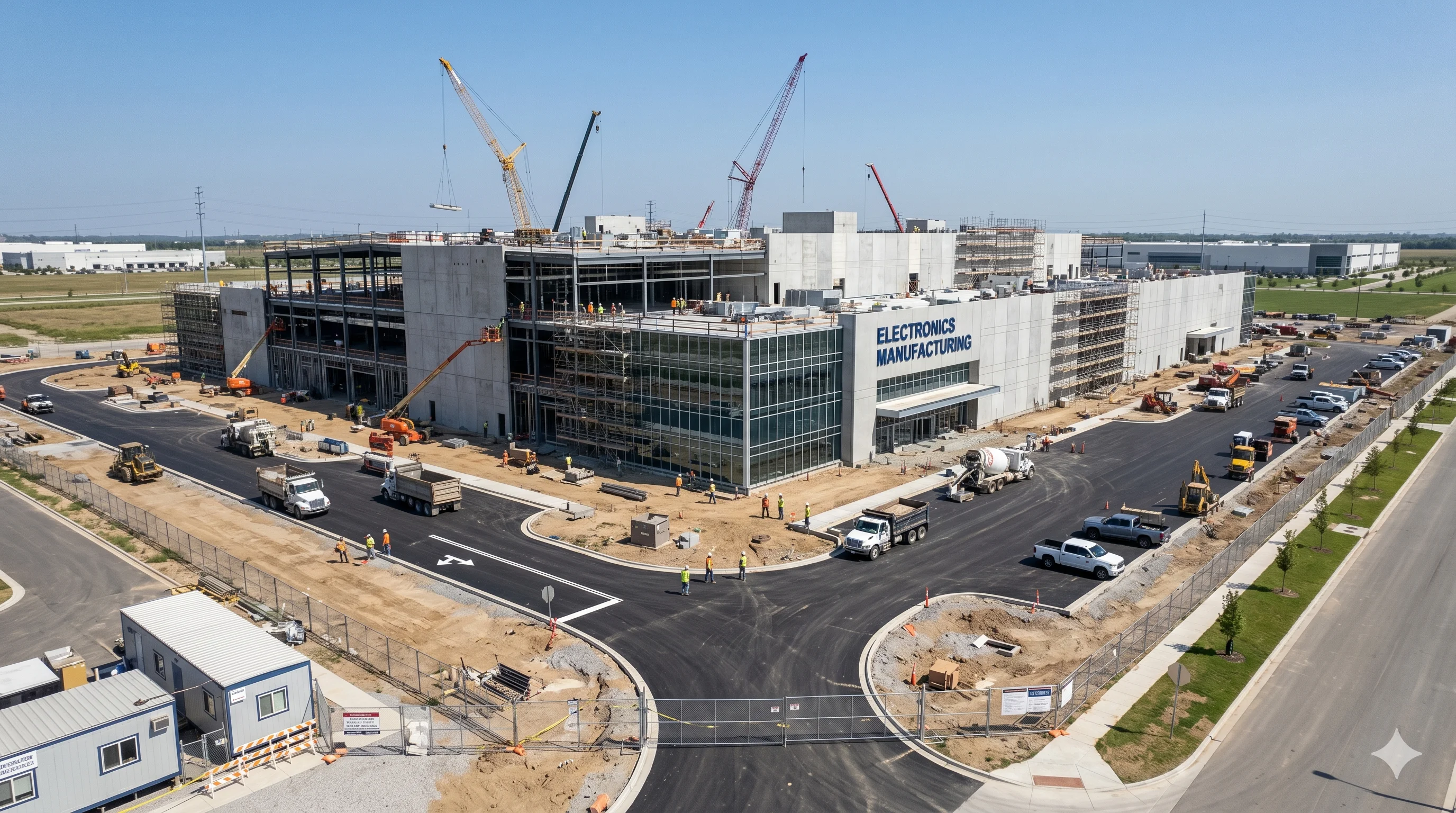
India's first commercial semiconductor plant is being built in Dholera. The investor: Tata Electronics. The investment: ₹91,000 crore. The current status: 50% construction complete as of April 2026. First chips targeted for 2026–27.
If you are considering a Dholera plot investment and this is the first time you are reading about this — take a moment to let that number sink in. ₹91,000 crore. Not a government promise. Active construction. On the ground, right now.
This article explains what this plant means for Dholera's economy, why it was placed here specifically, and what it historically does to land prices near any large industrial anchor of this scale.
The Plant — Key Facts
- Investor: Tata Electronics Private Limited
- Technology partner: PSMC (Powerchip Semiconductor Manufacturing Corporation), Taiwan
- Total investment: ₹91,000 crore (includes central government incentives)
- Technology node: 28nm (transitioning to 22nm)
- Construction status: ~50% complete as of April 2026
- First chips target: 2026–27
- Jobs created: 1,00,000 direct + indirect employment
- Location: Dholera SIR, Gujarat — inside the activated zone
The chips produced here will power applications across electric vehicles, telecom infrastructure, defence electronics, consumer appliances, and automotive systems. India currently imports virtually all its semiconductors. This plant is the first step toward changing that.
Why Dholera? The Honest Reason
Tata had choices. They chose Dholera. Why?
Four reasons, in order of importance:
- Power: A semiconductor fab needs massive, reliable industrial-grade power. Dholera has a 1,200+ MW solar park plus dedicated industrial power infrastructure — something most Indian industrial zones cannot match.
- Water: Fab manufacturing requires treated water supply. Dholera has Narmada canal water connected to the activation zone. No other greenfield zone in India had this combination ready.
- Land & clearances: Dholera SIR is a greenfield Special Investment Region with pre-approved land use, industrial clearances, and a dedicated authority (DSIRDA). No legacy encumbrances. No panchayat complications.
- Connectivity: The Ahmedabad–Dholera Expressway (inaugurated March 31, 2026) + upcoming semi-HSR rail + international airport in final construction — three modes of freight and passenger connectivity simultaneously.
No other location in India had all four at once. That is why Tata chose Dholera.
The Ecosystem Effect — Who Else Is Coming
A ₹91,000 crore semiconductor fab does not operate in isolation. It creates a supplier and services ecosystem around it. Companies already committed or present in Dholera's industrial zone:
| Company | Sector | Status |
|---|---|---|
| Micron Technology | Memory chips (DRAM/NAND) | Committed |
| CG Power + Renesas | Power semiconductors | Investment committed |
| Kaynes Technology | Electronics manufacturing | Committed |
| ABB / Siemens / Bosch | Industrial automation | In pipeline |
When a tier-1 anchor arrives, tier-2 and tier-3 supply chain companies follow within 2–4 years. This is not a theory — it is what happened in Hyderabad (HITEC City), Pune (Hinjewadi), and Bengaluru (Whitefield). Each of those corridors saw dramatic land value appreciation 5–10 years after the anchor industry established itself.
The Historical Comparison — What Happens to Land Near a Large Industrial Anchor
The pattern is consistent across Indian industrial corridors:
| Location | Anchor | Land Price: Before | Land Price: After 10–15 years |
|---|---|---|---|
| Hyderabad — Hinjewadi | IT/Infosys/Microsoft | ₹200–400/sqft | 8x appreciation |
| Pune — Chakan | Volkswagen, JCB, Mahindra | Base level | 4–6x in 12 years |
| Bengaluru — Whitefield | GE, ABB, Infosys | Base level | 10–15x over 20 years |
| Noida Expressway | IT parks, Samsung | ₹1,500/sqft (2005) | ₹8,000–12,000/sqft (2026) |
Dholera is at the same stage these corridors were in the early 2000s — before the anchor industries became visible to the general public. The Tata plant is at 50% construction. The airport is nearly ready. The expressway is open. The early-mover window is not closed yet.
The 1,00,000 Jobs Problem — And Why It Matters for Plots
One lakh jobs at Tata's plant alone. Add indirect employment — logistics, canteen, transport, maintenance, security, housing, retail — and the actual economic footprint is 3–4x that number.
Where will these people live? Not in Ahmedabad, 100 km away. They will live in Dholera SIR and its adjacent settlements.
Residential demand from industrial workers + management + families creates a housing and land market. This is not speculation — this is how every industrial corridor develops.
The plots being sold today in TP1 and TP2 activation zone are exactly the land that will house this demand.
The Question I Get Most Often
"Tata plant is nice, but when will it actually affect prices?"
My honest answer: prices have already started moving. The plots I saw at ₹600–700/sqft in 2020 are now at ₹1,000–1,300/sqft in the activation zone.
The bigger re-rating — the Hyderabad/Bengaluru-type jump — will come when the plant is at full production and the airport is operational. That combination typically takes 5–7 years from where we are now.
The question is not whether it will happen. It is when you want to be holding the asset — before or after that re-rating.
Want to know which plots are available right now in Dholera's activation zone?
I have visited the site 4 times. I can show you exactly where the Tata plant is, where the activation zone boundary runs, and what is currently available. No sales pressure — just honest information.
📞 +91 99113 32635 · Saurabh Gupta · RERA-registered broker
Continue Reading