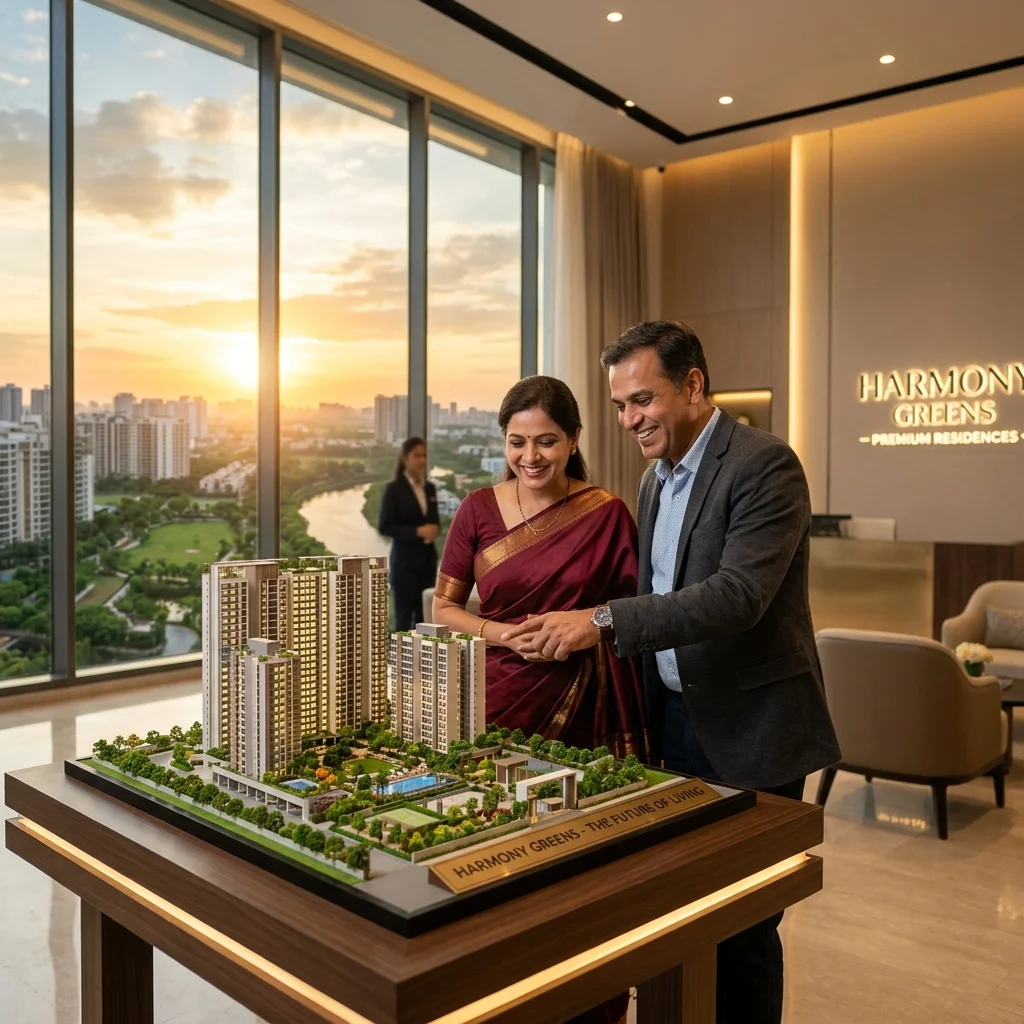
Most people I meet at 40 are still thinking about retirement the way their parents did — PPF, FD, and "maybe a flat someday." That worked in 1995. It will not work in 2026. If you are 40 years old today and have not started building a real retirement corpus in property, this guide is the most important thing you will read this year. Not because I am selling you something — but because I have watched 200+ clients get this right, and a few get it very wrong. I want you to get it right.
Why 40 Is Actually the Perfect Age to Invest in Property for Retirement
There is a strange narrative in India that 40 is "late" for big investments. It is not. In fact, for real estate specifically, 40 is the ideal entry point — and here is why.
At 40, you likely have three things that a 28-year-old does not: accumulated capital (savings, stocks, a maturing LIC policy), income clarity (you know what you earn and what you will earn for the next decade), and most importantly, 20 years of compounding runway before the typical retirement age of 60.
Twenty years in infrastructure-led real estate is not just good — it is transformational. The Dholera investors who bought in 2019 have already seen 3.1× to 4.6× appreciation. They are only 5–6 years into a 15-year infrastructure build-out. The investors who buy in 2026 get the next leg of that journey: airport opening, rail connectivity, semiconductor fab operations. The compounding is far from over.
The second reason 40 is ideal: you still have the income to service a loan if needed, but you can also deploy a lumpsum and let it work. At 55, banks become reluctant on long-tenure loans. At 40, you have full access to product choice.
The third reason, which nobody talks about: at 40, you have enough life experience to avoid the stupid mistakes. You have seen colleagues get burned on builder fraud. You know someone who bought in a ghost township. That experience makes you a smarter buyer — not a scared one.
The Math Nobody Puts in Front of You
Let us start with numbers, because feelings about property are worthless without math. The following table compares what happens to a one-time investment of ₹50 lakhs across different asset classes over 20 years. No monthly SIPs, no additions — just one lumpsum working for two decades.
| Asset Class | Assumed Return | ₹50L grows to (20 years) | Notes |
|---|---|---|---|
| Bank FD (Senior Citizen) | 6.5% p.a. | ₹1.78 Crore | Fully taxable as income; real return post-30% tax bracket is ~4.5% |
| Equity Mutual Fund | 12% CAGR | ₹4.82 Crore | LTCG @10% on gains above ₹1L/yr; market risk; needs discipline |
| Infrastructure RE (Dholera model) | 15% CAGR | ₹8.18 Crore | LTCG with indexation; illiquid; hold 10–15 years for best outcome |
| Commercial RE + Rental (Effective) | 18% effective | ₹13.7 Crore | Capital appreciation + rental income reinvested; ISBT model; pre-leased |
The FD number looks safe but it is not. At 6.5% nominal with inflation running at 5–6%, your real return is near zero. You are preserving capital, not growing it. The ₹1.78 crore in 2046 will buy roughly what ₹60–70 lakhs buys today.
The infrastructure real estate and commercial numbers are not fantasy. They are based on what I have seen in the field — Rajpath Enclave plots bought at ₹250/sqft in 2019 are trading at ₹800–900/sqft in resale today (3.1× to 3.6×). Supreme 1 buyers at ₹850/sqft in early 2024 are already sitting on a value of ₹2,100/sqft (2.5× in 14 months). The airport is not yet open. The rail is not yet running. This is still early-stage infrastructure pricing.
The Three-Bucket Strategy for 40+ Investors
I do not believe in putting everything into one property type. The smartest retirement portfolios I have seen use three buckets, each serving a different purpose. Think of it as a retirement tripod — stable only when all three legs are in place.
Bucket 1 — Growth (Dholera Plot, 10–15 Year Horizon)
This is your wealth-creation engine. A plot in an infrastructure zone — specifically Dholera SIR — that you buy today and do not touch for 10–15 years. No rental income, no annual visits required. You hold the land title, the land appreciates as infrastructure goes live, and you sell when the market is mature or pass it on to your children.
The Dholera thesis is straightforward: the Indian government has committed ₹3 lakh crore+ to DMIC (Delhi-Mumbai Industrial Corridor) infrastructure in this zone. The Dholera International Airport is under construction. A high-speed metro rail link to Ahmedabad is approved. Semiconductor fabs (Micron, Tata, others) are operational or under construction. This is not speculative — it is executed infrastructure that historically causes 3×–5× land price appreciation around it.
Your bucket 1 target: ₹25–40 lakhs in a Dholera plot (250–400 sqyd range at Rajpath Supreme 1 or Supreme 2 pricing). Hold until airport opens fully, around 2028–2030. Review then.
Bucket 2 — Income (Commercial Unit at ISBT, From Day 1)
This bucket solves the income problem before you retire. An ISBT Kaushambi or Sahibabad commercial studio or retail unit, pre-leased, generating rental from the moment you register. No tenant hunting, no vacancy risk in the first year, guaranteed footfall from 2 lakh+ daily ISBT commuters.
The math on ISBT commercial: a unit at ₹18–25 lakhs generates ₹6,000–10,000/month in rental. That is a 4–5% gross yield on a commercial unit with 7–10% annual appreciation. When you retire at 60, that rental becomes your monthly salary supplement.
Your bucket 2 target: ₹18–30 lakhs in a pre-leased commercial unit. Start receiving income immediately. Use that income to fund bucket 3 over time.
Bucket 3 — Lifestyle (Retirement Home in Haridwar)
This is where you will actually live after 60. Not where you will park money — where you will spend your mornings. Haridwar offers what very few retirement destinations in India can: an average annual temperature of 20–25°C, a 3-crore-plus annual pilgrim economy that keeps rental demand perennially high, strong healthcare infrastructure (Rishikesh AIIMS is 30 km away), and 8–10% annual property appreciation.
A 1BHK studio in a managed Haridwar development at ₹20–35 lakhs gives you the option to move in at retirement or rent it out until then. Either way, you win. If you rent it before moving in, pilgrimage-season rental income can be substantial — some owners earn ₹50,000–70,000 in a single festive month.
Your bucket 3 target: ₹20–35 lakhs in a Haridwar 1BHK or studio. Buy at 45–50, rent it until 60, live in it after.
Total three-bucket investment range: ₹63–1.05 crore deployed across a decade, with income flowing from bucket 2 from day 1, bucket 3 appreciating steadily, and bucket 1 compounding aggressively for the big exit at retirement.
Tax Advantages That 40+ Investors Almost Always Miss
I have had conversations with chartered accountants who did not know Section 54F fully. This section of the Income Tax Act is one of the most powerful retirement-planning tools available to Indian investors, and it is almost entirely ignored outside tax practitioner circles.
Section 54F — The Most Underused Tax Benefit in India
Here is the rule in plain English: if you sell any long-term capital asset (shares, mutual funds, gold, an old plot, commercial property) and invest the entire net sale consideration into ONE new residential property within 2 years of sale (or 1 year before sale), your entire capital gains tax liability is ZERO.
Example: You have ₹30 lakhs of equity mutual funds you bought 8 years ago. They are now worth ₹80 lakhs. Your capital gain is ₹50 lakhs. Normally, you would pay 10% LTCG = ₹5 lakhs in tax. Instead, you redeem the funds and invest ₹80 lakhs (the full sale consideration) into a Haridwar flat or Dholera residential plot within 2 years. Tax liability: ₹0.
The conditions that matter:
- You must not own more than one residential house at the time of sale (one existing home is allowed)
- The new property must be residential — a plot counts if it has a residential end-use designation
- If you sell the new property within 3 years, the exemption is withdrawn
- Full exemption only if full sale consideration is reinvested; partial reinvestment gives proportional relief
For someone at 42–48 with accumulated equity wealth that has compounded over a decade, this is an enormous planning opportunity. Redeem, reinvest in property, save lakhs in tax, and the property itself continues to appreciate. I have structured this for several clients — the savings are real and material.
Section 54 — Property to Property Rollover
If you are selling an existing residential property and buying another residential property, Section 54 exempts the capital gains. You must invest in the new property within 2 years (purchase) or 3 years (construction). This is the classic upgrade-home mechanism, and it also applies when selling a family ancestral property to redeploy into a retirement home.
Section 24(b) — Home Loan Interest Deduction
If you take a home loan (not a plot loan — a constructed property loan), Section 24(b) allows you to deduct up to ₹2 lakhs of interest paid per financial year from your taxable income. For someone in the 30% tax bracket, this is a ₹60,000 annual tax saving. Over a 10-year loan, that is ₹6 lakhs of real tax saved — not theoretical.
LTCG with Indexation — Hold 3+ Years
When you eventually sell a property held for more than 24 months (2 years, as of the 2024 Budget revision), you pay Long-Term Capital Gains tax. The indexed cost of acquisition — adjusted for inflation using the Cost Inflation Index published by the government — significantly reduces your taxable gain. In practice, on a property held 10–15 years, the effective tax rate on real appreciation is often 5–8%, not the headline 20%.
Note: the 2024 Union Budget changed real estate LTCG to 12.5% without indexation (new default) OR 20% with indexation, with a taxpayer option to choose the lower. This is a pro-taxpayer change for most long-hold investors. Always compute both before selling.
Strategy by Age Bracket — What to Buy at What Age
Not everyone at 40+ is the same. A 41-year-old in the peak of their career and a 53-year-old approaching pre-retirement have entirely different risk tolerances and timelines. Here is how I calibrate the advice:
Age 40–45: Aggressive — Maximum Growth Window
You have 15–20 years to retirement. This is your single best window for a high-growth infrastructure plot. Go long on Dholera. Buy the largest plot you can comfortably afford without straining cash flow. If you have accumulated equity or stocks, consider a Section 54F redemption and reinvestment. Do not worry about rental income yet — growth is the priority.
- Primary: Dholera plot (Rajpath Supreme 1 or Supreme 2 EOI)
- Secondary: ISBT commercial unit for cash flow (if budget allows)
- Skip for now: retirement home — too early, your needs at 60 will be clearer at 48
Age 45–50: Balanced — Growth Plus First Income Stream
You have 10–15 years. Time to add a commercial unit that starts generating rental income now. That rental income compounds separately — use it to fund your retirement home bucket over 5–7 years. The Dholera plot (if bought at 42–45) should already be showing appreciation. If you are entering fresh at 47, you can still buy Dholera but supplement with commercial for balance.
- Primary: ISBT commercial unit — start income stream
- Secondary: Dholera plot if not already held
- Begin planning: Haridwar retirement home — site visit, shortlist
Age 50–55: Conservative — Income and Lifestyle Focus
You have 5–10 years. Risk appetite should reduce. The priority now is securing income and locking in your retirement lifestyle asset. A large Dholera bet at 52 is a 10-year hold — still viable if capital is available, but do not leverage it. Focus on commercial yield and your retirement home.
- Primary: Haridwar retirement home — buy now, rent until retirement
- Secondary: Commercial unit if not held
- Dholera: smaller plot position if budget allows — treat it as bonus corpus, not core
Why Dholera Specifically for Your Retirement Corpus
I know this sounds like a sales pitch. Stay with me, because the underlying case is based on government-committed infrastructure, not developer promises.
The Dholera Special Investment Region is a 920-square-kilometre greenfield smart city planned under the Delhi-Mumbai Industrial Corridor — one of the largest infrastructure projects in Indian history, with Japan and Singapore as development partners. The Indian government has already committed and partially disbursed over ₹3 lakh crore in the DMIC corridor. This is not a builder's township — this is sovereign infrastructure.
Here is what the appreciation data actually looks like from my own clients' portfolios:
- Rajpath Enclave (bought 2019–2020 at ₹250–280/sqft): Current resale ₹800–900/sqft. That is 3.1× to 3.6× in 5–6 years.
- Rajpath Green City (early investors at ₹180/sqft): Sold out; secondary market at ₹800+/sqft. 4.4× to 4.6× appreciation.
- Rajpath Supreme 1 (entry at ₹850/sqft in early 2024): Current developer price ₹2,100/sqft. 2.5× in approximately 14 months. Airport not yet open.
The current entry price for Rajpath Supreme 2 is approximately ₹1,000–1,100/sqft. When the Dholera International Airport becomes operational and the Ahmedabad metro rail link opens, projections — and I mean conservative projections based on comparable airport-vicinity land pricing in Hyderabad and Pune — point to ₹3,000–4,000/sqft. That is a 3×–4× from current prices, before any rental income is considered.
For a retirement corpus, that trajectory over 10–15 years is what moves the needle. FDs do not do this. Mutual funds can, but they carry market-cycle risk at the moment of redemption. Infrastructure land, once the infrastructure is live, tends to hold value and continue appreciating because supply does not expand — you cannot create more land next to an airport.
Why Haridwar for Retirement Living
Every client who asks me about a retirement home eventually comes back to Haridwar. Not because I push it — because it solves the actual problem. Let me explain what the actual problem is.
The problem is not "where to live." The problem is: where can I live comfortably on a modest pension, in a peaceful environment, with good healthcare, where my property will not depreciate, and where I can generate rental income in the years before I move in?
Haridwar answers all five:
- Climate: 20–25°C annual average, with proper seasons, no extreme summers, no coastal humidity. Retirees consistently rate the climate as their primary reason.
- Spiritual infrastructure: Over 3 crore annual visitors. Year-round religious activity. Kumbh Mela draws 50+ crore in peak years. This is not a quiet hill station — it is a living, economically active pilgrimage city.
- Healthcare: AIIMS Rishikesh is 28 km away — one of India's top government hospitals. The Haridwar–Rishikesh belt has multiple private hospitals (Shivalik, Max, HIMS). For a retiree, this access matters enormously.
- Pre-retirement rental income: A managed 1BHK near the Ganga or the main pilgrim circuit earns ₹12,000–20,000/month in regular months, and ₹40,000–70,000+ during Ardh Kumbh, Kanwar Yatra, and festival seasons. A management company handles this if you are based in Delhi NCR.
- Appreciation: 8–10% annual appreciation, driven by limited supply (Haridwar is a holy city with strict construction regulations) and rising pilgrim income. This has been consistent over the last decade.
Why ISBT Commercial for Passive Income
If Dholera is the growth engine and Haridwar is the lifestyle asset, ISBT commercial is the income factory — and the one that requires the least active management.
ISBT Kaushambi is one of the busiest inter-state bus terminals in North India, serving over 2 lakh daily commuters from Uttar Pradesh, Uttarakhand, and the eastern NCR belt. The footfall is not seasonal — it is structural. People travel daily. The commercial units inside or immediately around the terminal benefit from that captive footfall whether the economy is booming or not.
What makes this specifically attractive for a 40+ retirement investor:
- Pre-leased from Day 1: The tenant is already in place when you register. Your first rental credit can hit your account within 30 days of possession. No vacancy risk, no agent fees, no negotiation.
- Rent escalation clause: Typically 12–15% every 3 years, contractually written in. Your income grows even if you do nothing.
- No maintenance headache: Commercial tenants manage their own interior; common areas handled by the facility management. You collect rent and file taxes. That is it.
- Entry price: Studios and retail units start at ₹18–25 lakhs — accessible even if you are deploying a smaller amount into this bucket while your Dholera plot takes the bulk.
The Mistakes 40+ Investors Make in Property — And Regret
I want to be honest here because the point of this guide is not to make you feel good — it is to help you avoid errors that I have watched others make. These are real mistakes from real clients.
Buying in Their Home City Because They Know It
This is familiarity bias, and it is expensive. A client from Lucknow will buy a flat in Gomti Nagar because "I know the area." A client from Patna will buy something in Boring Road. The problem: those cities do not have the infrastructure catalysts that drive 3×–5× appreciation. You are paying for comfort, not return. Infrastructure-led growth happens where the government has committed money — not where you grew up.
Going Residential When Commercial Gives Better Yields
Residential rental yield in Indian metros is 2–3%. Commercial yield is 4–6%. For a retirement income strategy, this difference is enormous over 15 years. I see clients buy a ₹60 lakh flat that earns ₹12,000/month (2.4% yield) when the same ₹60 lakhs in commercial units could earn ₹25,000–30,000/month (5–6% yield). The flat also costs more in maintenance, tenant management, and vacancy risk.
Waiting for "The Right Time"
I have heard this every year since 2019. "Dholera might fall." "Let the airport get confirmed." "Let the price stabilise." Every person who said that in 2020 missed the 4.6× Green City run. Every person who said it in 2023 missed Supreme 1's 2.5× in 14 months. The right time was 5 years ago. The second-best time is today — before the airport opens, before the rail runs, before Supreme 2 is fully launched. After those catalysts hit, the early-stage pricing window will be permanently closed.
Not Diversifying Across Property Types
Putting ₹80 lakhs into one residential flat in Noida is not a retirement strategy — it is a single bet. The three-bucket model exists precisely to avoid this. One asset for growth, one for income, one for lifestyle. They serve different purposes and have different risk profiles. Do not concentrate.
Ignoring Section 54F Completely
I have met investors with ₹40–60 lakhs of accumulated equity gains sitting in mutual funds, paying 10% LTCG every time they book profits, who have never heard of Section 54F. If they had simply planned one redemption-and-reinvestment cycle correctly, they could have saved ₹4–6 lakhs in tax and simultaneously deployed that capital into appreciating property. Tax planning and property planning must happen together, not in separate silos.
One Honest Conversation — My Process With Every Client
I want to be clear about how I work, because a lot of people expect a high-pressure sales call. That is not what happens.
When you reach out to me, the first thing I ask is not "what is your budget?" It is "what problem are you trying to solve?" Are you trying to create a retirement corpus? Generate monthly income? Find a place to live at 60? Gift an asset to your children? The answer changes everything about what I recommend.
From there, the process is straightforward:
- Understand your goal and timeline: A 30-minute call, no obligation. I ask questions, you answer honestly. I may tell you that property is not the right vehicle for your specific situation — it has happened.
- Match property to goal: Based on your timeline, budget, risk tolerance, and tax situation, I identify one or two specific properties that match — not a catalogue of options designed to overwhelm.
- Share all documents: RERA registration, title documents, developer credentials, sample agreement. No pressure, no urgency manufacturing. Review everything with your lawyer if you want.
- Arrange a site visit: For Dholera, I do periodic group site visits where you see the airport construction, the road network, the active phases. For Haridwar and ISBT, I coordinate individual visits.
- Decide at your pace: I give you a clear picture of what you are buying and why. The decision is yours. I do not follow up ten times a day. If the investment makes sense for you, you will know.
I have had clients who called me in January, did their diligence for four months, and registered in May. That is fine. I have had clients who called on a Monday and wanted to block a unit by Friday. That is also fine, as long as the diligence is real.
Frequently Asked Questions
Can I buy property in my wife's name for tax benefits?
Yes, and it is a legitimate planning strategy. If your wife has a lower tax bracket or no taxable income, registering property in her name means rental income is taxed at her rate (potentially 0% or 5%), not yours (potentially 30%). Capital gains on eventual sale are also taxed at her rate. However, the purchase funds should demonstrably come from her income or gifted from you (gift is tax-free between spouses). Consult your CA before structuring — the arrangement needs to be genuine, not a paper fiction.
What is stamp duty on property for senior citizens?
Stamp duty varies by state. In Uttar Pradesh (where ISBT Kaushambi and Sahibabad projects are located), standard stamp duty is 7% for men and 6% for women. Gujarat (Dholera) charges 4.9% for men and 3.9% for women. Uttarakhand (Haridwar) charges 5% for men and 3.75% for women. Most states do not offer a senior citizen concession specifically on stamp duty — the gender concession (women pay less) is the main reduction available. Registering in a female family member's name can save 1–1.5% of the property value.
Is Haridwar property a good investment in 2026?
Yes — with nuance. The pilgrim economy is not going away, and AIIMS Rishikesh has turbocharged the medical-value tourism angle. The 8–10% annual appreciation has been consistent. The risk is builder quality — there are many small local developers with poor construction track records. Stick to developers with a completed project visible and verifiable in Haridwar, not just a brochure. The properties I recommend are from developers I have personally visited and whose previous projects I have walked through with clients.
Can I get a plot loan after 50?
Plot loans (for land purchase without construction) are available from select NBFCs — major banks like SBI and HDFC are more selective. After 50, tenure is typically capped at the borrower's 65th birthday, so a 52-year-old may get a maximum 13-year loan tenure. Interest rates are 10–12% from NBFCs. Most lenders want the plot in an approved layout or RERA-registered project. The practical advice: if you are 50+ and considering a plot, try to deploy from capital rather than heavy leverage. The plot does not generate rental income to service EMIs, so a large loan on a non-income-generating asset is cash-flow negative every month.
What is the minimum investment for Dholera?
Rajpath Supreme 1 plots start at approximately ₹15–18 lakhs for smaller 100–150 sqyd plots (exact pricing changes with phase releases — confirm current inventory). For a meaningful retirement corpus position, I generally recommend 250–350 sqyd, which is ₹25–35 lakhs at current pricing. Supreme 2 EOI (Expression of Interest) is open — the launch pricing will be announced with launch, and EOI registrants typically get first access. Minimum EOI amount is nominal. If budget is a constraint, I help clients pool resources efficiently or phase the investment.
Ready to Build Your Retirement Plan Around Property?
If you are 40+ and have been putting off this conversation, this is your sign to have it. Not because I want to sell you something — but because the compounding window closes a little every year, and the Dholera entry-price window specifically closes when the airport opens.
I am Saurabh Gupta. I have helped 200+ clients structure property investments across Dholera, Haridwar, ISBT, and other income-generating assets. I do not do generic consultations — every conversation is tailored to your specific goal, timeline, and tax situation.
Call me, WhatsApp me, or fill the form below. The first conversation is completely free, completely honest, and completely no-pressure. Tell me where you are at 40 — I will tell you where property can take you by 60.