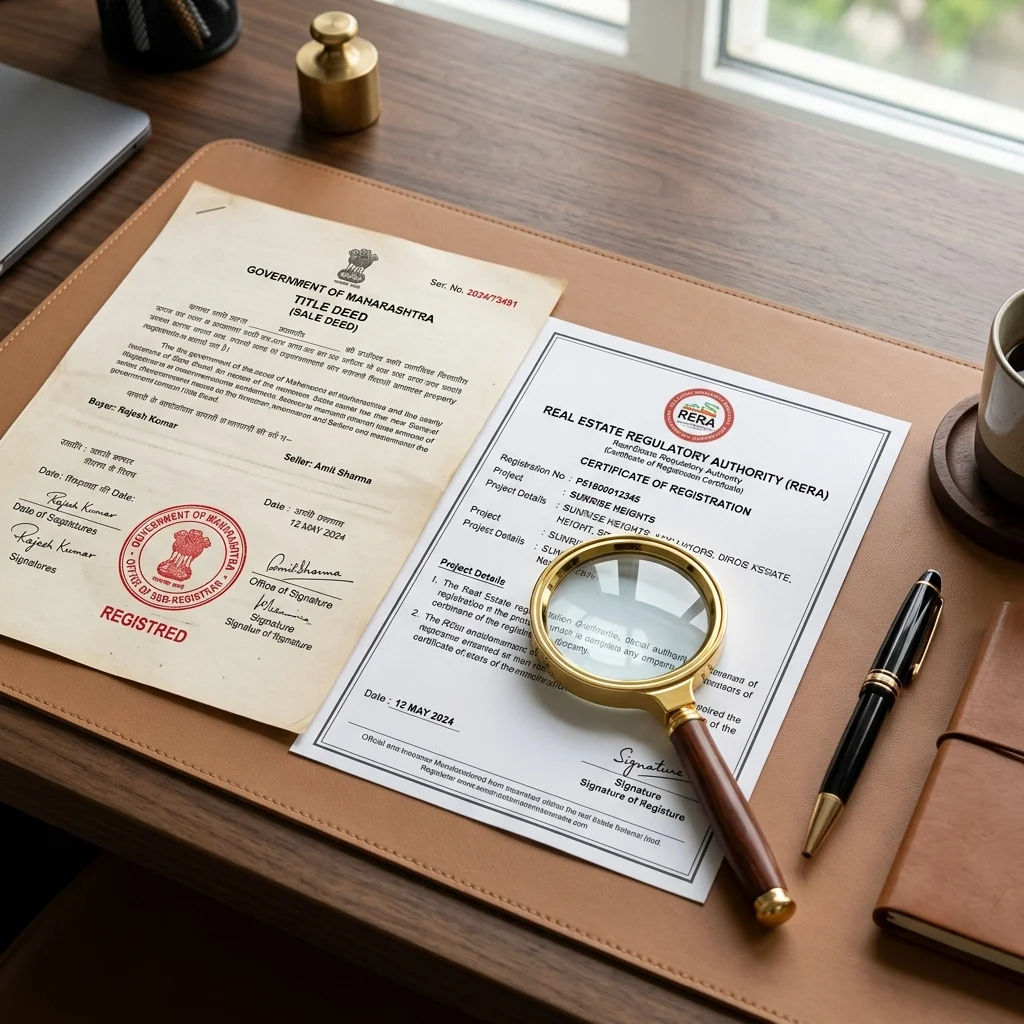
The most common mistakes in plot investment in India are not about choosing the wrong city — they are about not verifying documents before payment. This checklist tells you exactly what to ask for, what to check, and what to do when something is missing.
Before You Pay Anything: Essential Documents
1. RERA Registration Certificate
What it is: The state RERA authority's certificate confirming the project is legally registered.
Why it matters: Without RERA registration, you have no legal recourse under the RERA Act if the developer delays or defaults.
How to verify: Do not rely on a photocopy — verify the registration number directly on the state RERA portal (see state-wise portal list below).
What to check on the portal: Developer name, project name, possession date declared, quarterly progress reports filed, sanctioned layout plan downloaded.
2. Layout Plan Approved by Local Authority
What it is: The sanctioned layout plan from the local development authority (DSIRDA for Dholera, MVDA for Vrindavan, HRDA for Haridwar, ADA for Ayodhya, DDJAY/DTCP for Haryana, RIICO for Rajasthan industrial zones).
Why it matters: RERA registration alone does not guarantee the layout is legally approved for residential development — the layout plan approval is a separate, parallel verification.
What to check: Your specific plot number should appear in the sanctioned layout. Confirm the plot dimensions on the plan match what you are being sold.
3. NA (Non-Agricultural) Conversion Certificate
What it is: The state government order converting the land from agricultural use to residential/non-agricultural use.
Why it matters: In most Indian states, agricultural land cannot be sold as residential plots without NA conversion. Buying a plot on land without NA conversion can result in your ownership being legally challenged.
Exceptions: In some states, certain zone designations substitute for NA conversion — confirm with a local lawyer for the specific state and land type.
4. Title Documents — Chain of Ownership
What it is: The history of ownership going back typically 30 years — sale deeds, inheritance documents, court orders, and any previous mortgages.
Why it matters: A plot with a disputed title or an undisclosed mortgage can have its ownership legally challenged even after you register it in your name.
How to verify: Engage a licensed lawyer in the relevant state to conduct a title search and issue a Title Clear Report. This typically costs ₹5,000–₹15,000 and is one of the most valuable investments you can make before a plot purchase.
5. Encumbrance Certificate
What it is: A government document (from the Sub-Registrar's office) listing all registered transactions on the land — purchases, mortgages, charges, and legal notices — for a specified period.
Why it matters: An encumbrance certificate reveals whether the land is mortgaged against a loan (a common fraud scenario where a developer sells plots on land already pledged to a bank).
How to obtain: Request an EC for the survey number of the land for a 30-year period. In many states this can now be obtained online through the state's registration portal.
6. Registered Sale Agreement (Before Final Payment)
What it is: A legally registered agreement between buyer and seller/developer that specifies price, payment schedule, possession date, penalty clauses, and other terms.
Why it matters: Under RERA, a registered sale agreement is mandatory for any advance payment exceeding 10% of the total price. Without a registered agreement, you have limited legal protection.
Key clauses to check: Possession date, penalty for delay (should be as per RERA — interest at RBI MCLR + 2%), your right to cancel and get refund, and whether the agreement is registered (not just notarised).
State-Wise RERA Portal Quick Reference
- Gujarat (Dholera): gujrera.gov.in
- Uttar Pradesh (Ayodhya, Vrindavan, Varanasi, Bareilly, Muzaffarnagar): up.rera.gov.in
- Rajasthan (Neemrana): rera.rajasthan.gov.in
- Haryana (Kharkhoda, Rohtak): haryanarera.gov.in
- Uttarakhand (Haridwar, Rudrapur): ukrera.uk.gov.in
After Registration: Mutation (Dakhil Kharij)
After your sale deed is registered at the sub-registrar's office, apply for mutation at the local tehsildar/patwari office. Mutation updates the government land revenue records to show your name as the new owner. It is not mandatory under registration law but is essential for: future resale, construction permissions, utility connections, and establishing your rights as owner against the previous owner's records. Apply within 90 days of registration.
A Note on Payment Timing
Never make any payment — even a token advance — before seeing the RERA registration number. Never make a payment above 10% of the total price without a registered sale agreement. Never pay in cash — all payments should be traceable bank transfers to the developer's RERA-linked escrow account.
All projects listed on SmartCityPlots come with RERA documents and layout approvals shared before any payment is requested. If you are evaluating a plot offer from any source and want a document verification check, contact Saurabh — this advisory service is free.